


Self-healing concrete: how bacteria in concrete works to heal itself.
The construction industry is witnessing a shift toward resilient and autonomous materials, with self-healing concrete (also known as bio-concrete) leading the charge for 2026. This technology allows foundations and slabs to repair their own cracks, potentially eliminating the need for expensive exterior waterproofing membranes and reducing long-term maintenance costs. That sounds like science fiction I'm sure, but rest assured this really is a 'thing', and it works.
This technology has been in the works for a few decades, and while its not widely available yet, it is at least well into the development and testing stage. Once in a while some new technology or product hits the home building market that has an enormous impact, we're hopeful that this will be one of those. Beyond its ability to repair existing foundations, concrete poured in new foundations would mean they are able to heal their own cracks.
- How self-healing concrete works
- Biological vs crystalline healing agents
- Benefits for new residential construction
- Repairing and retrofitting older basements
- Self-healing solutions for block foundations
- Current availability in the US and Canada
- In brief
How self-healing concrete works
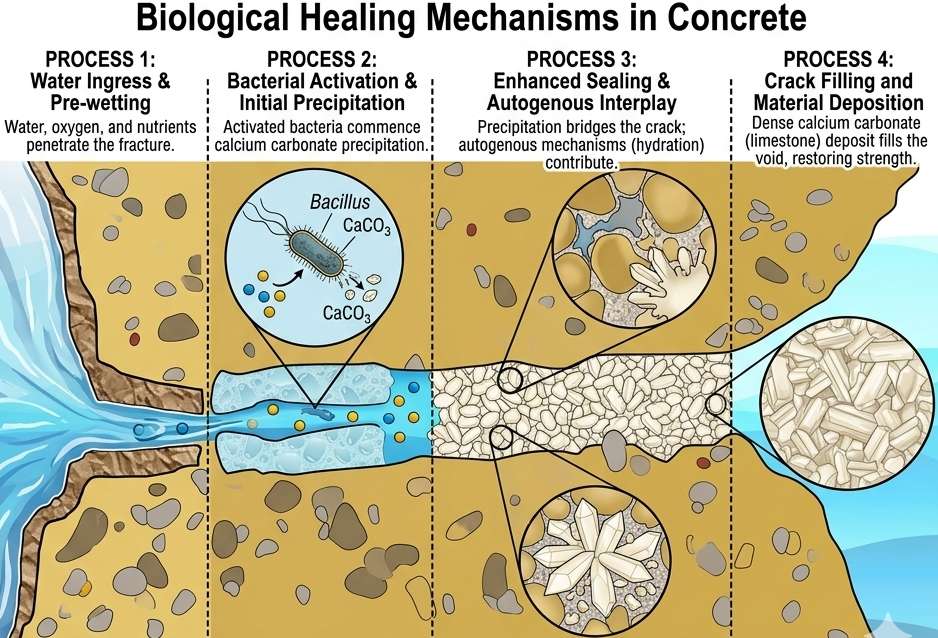
The most basic explanation about self healing concrete is that bacteria intentionally added to concrete begins to grow when exposed to moisture. This biological or chemical process that repair structural damage without human intervention.
Standard concrete is naturally prone to vertical shrinkage cracks, which leads to structural damage, as well as radon gas contamination of basements. Bio-concrete addresses this by embedding repair agents directly into the mix.
- Encapsulation: Specific strains of extremophile bacteria (such as Bacillus) and a nutrient source are placed inside tiny, clay-based pellets.
- Activation: When a crack forms and water or air enters the fissure, the capsules break open, and the moisture wakes up the dormant bacteria.
- Healing: The bacteria consume the nutrients and convert them into calcium carbonate (limestone).
- Sealing: This limestone fills the crack, physically sealing it from the inside out and protecting the internal steel reinforcement from corrosion.
Biological vs crystalline healing agents
While bacterial-based concrete is the emerging 'coming soon' technology for residential markets, crystalline admixtures are already a proven and available method for creating self-healing foundations in North America. Understanding the difference is key for selecting the right system for a sustainable build.
Bacterial bio-concrete admixtures
Bacterial systems like those from Basilisk are highly effective at sealing cracks up to 0.04 inches (1 mm) wide. These are often categorized as biotic healing agents. They are currently transitioning from large-scale infrastructure projects like bridges and tunnels into the high-performance residential sector.
Crystalline waterproofing technology
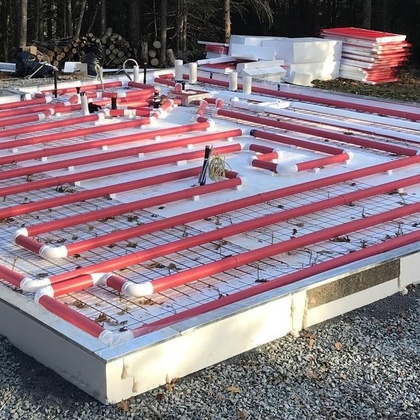
Crystalline admixtures, such as those produced by Kryton or Xypex, use a chemical reaction rather than bacteria. When moisture is present, these chemicals grow non-soluble needle-like crystals that fill the pores and capillary tracts of the concrete. This technology is widely used in Canada and the US today and is a standard choice for ICF basements and frost protected shallow foundations (raft slabs).
Benefits for new residential construction
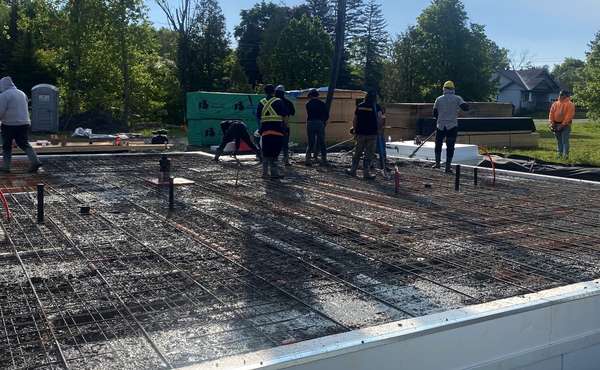
Integrating self-healing properties into a new home foundation offers several advantages for energy efficiency and resilience. By making the concrete itself the primary water barrier, builders can simplify the building envelope.
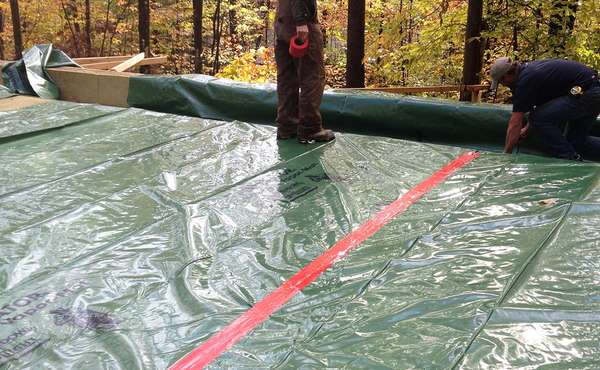
Eliminating external membranes is a major benefit of using self-healing admixtures. Traditional bituthene or spray-on membranes can be damaged during backfilling or degrade over time. A self-healing slab or wall remains protected throughout its entire thickness. This approach is particularly effective for slab-on-grade foundations, where the concrete serves as both the structure and the finished floor.
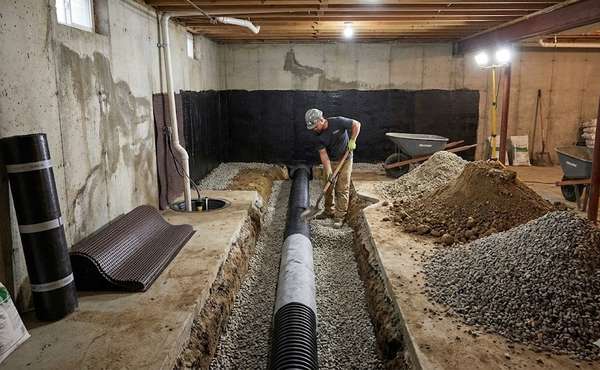
Repairing and retrofitting older basements
For homeowners finishing an existing basement, self-healing technology is applied differently. While you cannot add bacteria to a cured wall, you can use autonomous repair kits to fix leaky cracks from the inside.
Injection-based healing uses moisture-activated resins or crystalline mortars that are pumped into fissures. If you are finishing a basement to prevent mold, sealing these cracks is the first step. These modern repair kits are designed to reactivate if new moisture is detected, providing a 'living' seal that adjusts to the freeze-thaw cycles common in cold climates like Canada and the northern US states.
Self-healing solutions for block foundations
While often associated with poured walls, self-healing technology is increasingly applicable to concrete masonry unit (CMU) or block foundations. Because block walls are assembly-based, the 'healing' must target both the porous blocks and the mortar joints.
Smart mortar and pre-treated blocks
The most common failure point in block foundations is the mortar joint. Self-healing mortar uses embedded bacteria or crystals to seal hairline cracks as they form, preventing the 'stair-step' leakage common in older homes. Additionally, pre-treated self-healing blocks are now being manufactured with admixtures integrated during the dry-cast process, making the masonry unit itself autonomous.
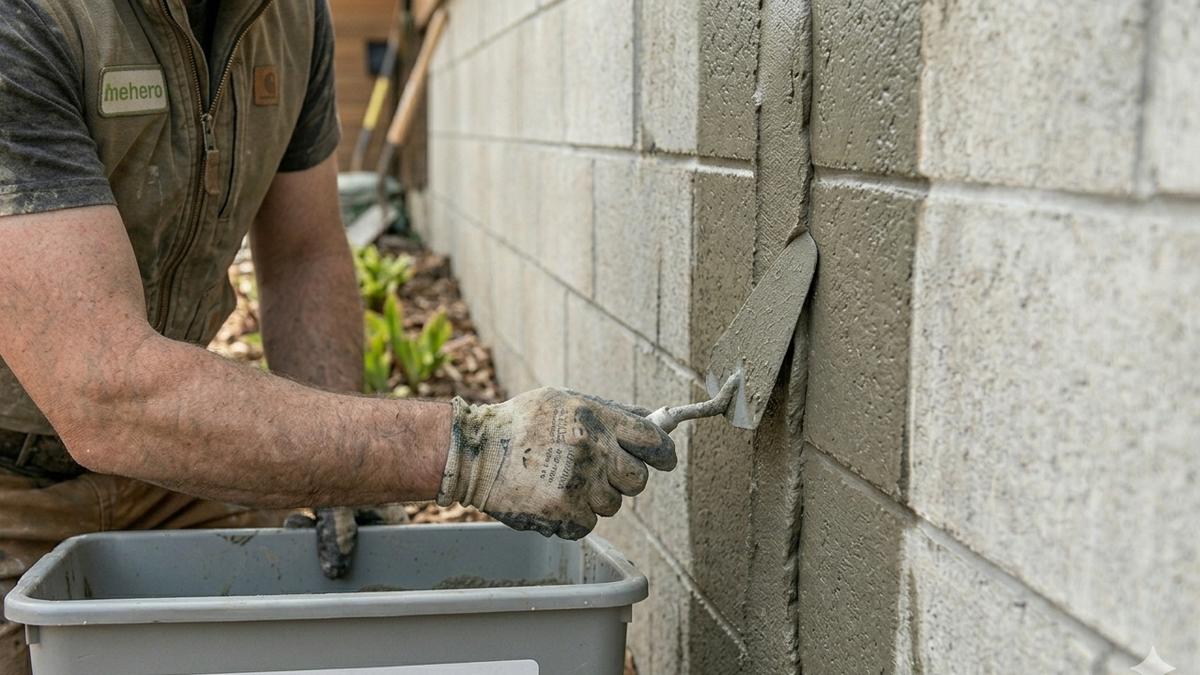
Crystalline parging for block retrofits
For existing block walls, a crystalline parge coat (such as Xypex Concentrate) is the most effective retrofit. Unlike standard parging, these coatings penetrate deep into the capillary tracts of the blocks and mortar. If water enters from the exterior, the crystals grow to block the path, effectively turning a porous block wall into a smart waterproof barrier.
Current availability in the US and Canada
While you cannot yet purchase bio-concrete in a pre-mixed bag at a local box store, the components are commercially available through professional distribution networks. For those building in 2026, here is how to source these materials:
- Kryton International (Canada): Based in Vancouver, they offer the Krystol Internal Membrane (KIM), a crystalline admixture available across Canada and the US that turns concrete into a self-healing water barrier.
- Xypex Chemical Corporation: Their crystalline technology is a staple in the North American market for waterproofing concrete from the inside or as a mix-in for new pours.
- Basilisk (Coming Soon): This bacteria-based agent is currently moving into North American distribution. It is typically sourced through B2B commercial suppliers but can be specified for residential projects seeking maximum carbon reduction.
- Sika Canada: Provides crack injection systems that use self-sealing chemistry, readily available at professional masonry and concrete supply houses in cities like Ottawa and Toronto.
In brief
Self-healing concrete is a transformative technology that allows foundations to autonomously repair cracks, preventing water ingress and radon gas migration. While bacterial-based bio-concrete is the upcoming frontier for residential building, crystalline admixtures are a currently available 'self-healing' solution that can eliminate the need for exterior membranes.
Whether you are building a new foundation, building with concrete blocks, or repairing an older basement, these smart materials offer a path to a more durable and sustainable home.
Now that you know more about self-healing concrete, find more info about resilient foundations and green building techniques in the Ecohome Green Building Guide and these pages below:
-
Can you waterproof basements from the inside?
-
Why basements flood and how to prevent basement flooding
-
Basement finishing: how to prevent mold
-
How much insulation does a basement need?















Comments (0)
Sign Up to Comment