



Aerogel in sustainable building: Is this the best new insulation material?
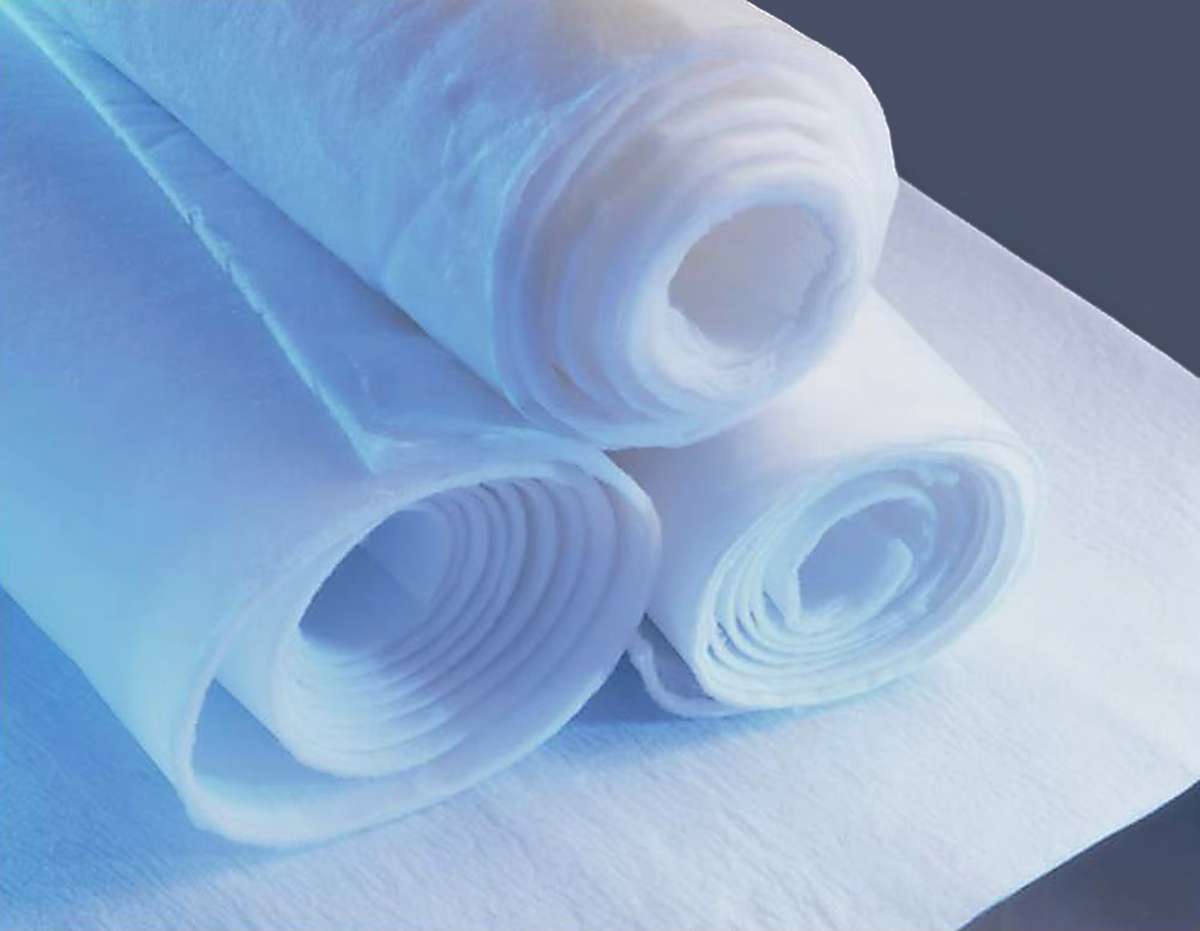
Aerogel is often called 'frozen smoke' because of its wispy, translucent appearance and extremely low density, and it provides extremely high R-values when incorporated into building materials. While it sounds like science fiction, this material is quietly revolutionizing how we approach insulation and window performance in sustainable homes.
This guide, written for both the eco-curious homeowner and the seasoned building professional, explores the science, applications, and regional use of aerogel to help you achieve a high-performance building envelope.
This guide provides a comprehensive look at the key aspects of this topic. Below is an overview of the sections we will cover, allowing you to jump directly to the information you need.
- What is aerogel and how is it made?
- Manufacturing aerogel: the supercritical drying process explained
- The thermal performance of aerogel: R-value, U-factor, and why it matters
- Applications in fenestration: high-performance windows
- Aerogel for wall and roof insulation
- How much do aerogel windows cost?
- Does aerogel have a high carbon footprint?
- Durability and tradeoffs
- Canadian, US and global suppliers of aerogel
- In brief: aerogel for sustainable construction
What is aerogel and how is it made?
Aerogel is technically a synthetic and porous ultralight material derived from a gel, in which the liquid component has been replaced with gas. The result is a solid composed of up to 99% air, making it one of the lightest solids on Earth. The most common type used in building is silica aerogel.
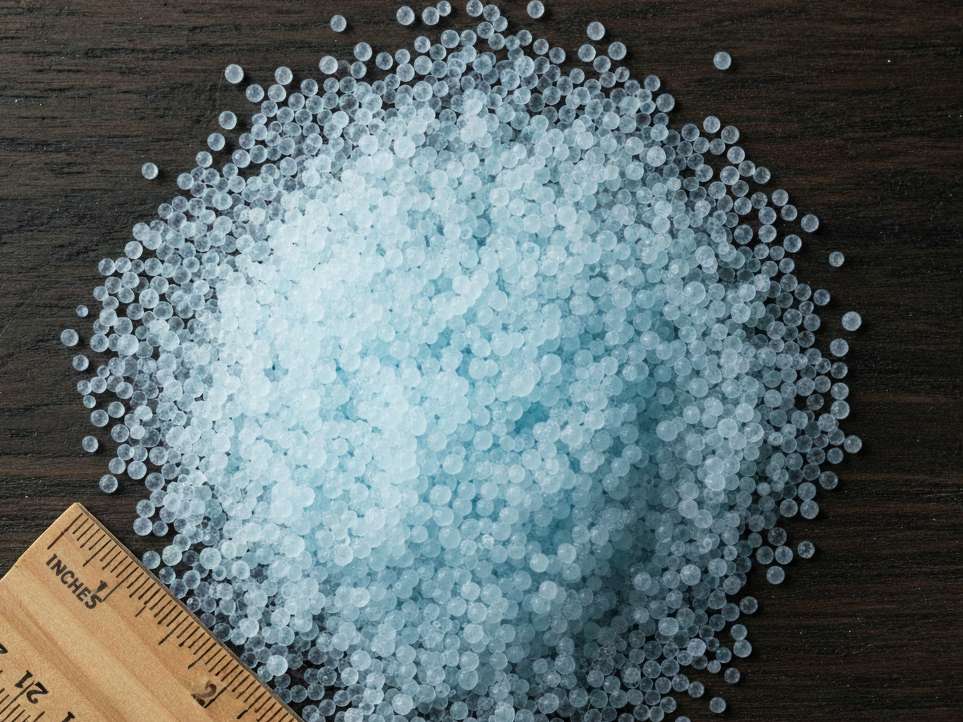
The unique structure is the secret to its insulating power. Air is an excellent insulator when it is hermetically sealed, but in the absence of a perfect seal, convection currents occur and transfer more heat. Aerogel’s internal structure is a complex network of nanoscale silica pores that trap air molecules in their own tiny bubble.
This severely limits air movement (convection) and minimizes the solid structure contact (conduction), while the silica structure itself absorbs most of the infrared radiation (radiation), effectively fighting all three major modes of heat transfer simultaneously. You can read here about radiation, convection and conduction - the three ways heat moves.
Manufacturing aerogel: the supercritical drying process explained
The manufacturing process is crucial to achieving its incredible properties. It begins with creating a gel, typically silica-based. The challenge lies in removing the liquid from this gel without collapsing the delicate, porous structure, which would turn it into ordinary silica. This is achieved through a process called supercritical drying.
- Gel formation: A liquid solvent is mixed with a precursor (like alcoxysilane) to form a wet gel.
- Supercritical extraction: The wet gel is placed in a pressure vessel and the liquid is slowly replaced with supercritical carbon dioxide (CO2). Supercritical CO2 has properties of both a liquid and a gas, allowing it to escape the pores without surface tension, preserving the intricate internal structure.
This labor-intensive process is a primary factor contributing to aerogel’s higher cost compared to conventional insulation materials like fiberglass or mineral wool.
High performance R Value and U Value of aerogel and why it matters:
For both homeowners seeking efficiency and professionals designing net-zero homes, aerogel offers exceptional thermal performance that can solve challenging building problems.
R-Value per inch comparison of common insulations
| Insulation type | Typical R-Value per Inch (ft2⋅h⋅∘F/BTU) |
| Fiberglass batts | R-3.0 to R-3.5 |
| Rigid foam (average) | R-4.0 to R-6.5 |
| Aerogel blanket | R-10 to R-12 |
R-value and U-factor explained
The performance of any insulation is measured by its resistance to heat flow. In North America (US and Canada), this is expressed as R-value (resistance). In the UK, Australia, New Zealand, and for fenestration globally, the inverse, the U-factor (or U-value, measuring heat transmission), is often used. A higher R-value means better insulation; a lower U-factor means less heat transfer and better performance.
The R-value of aerogel typically ranges between R-10 and R-12 per inch (RSI 1.76 to 2.11 per 2.5 cm), depending on the density and form (blanket, granules, or monolithic sheet). This is 2 to 4 times better than most conventional insulations like fiberglass batts (which average around R-3.5 per inch).
Addressing thermal bridging in construction
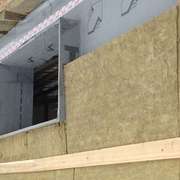
One of aerogel’s most critical uses is addressing thermal bridging, a major issue where heat finds a path around or through insulation via less resistive materials, typically the structural elements like wood studs or steel beams. The compact, high-R nature of aerogel makes it ideal for areas with limited space where traditional insulation fails, such as:
- Window and door reveals (where the frame meets the wall).
- Below sill plates and the gap in front of double headers.
- Around piping, electrical conduits, and junction boxes.
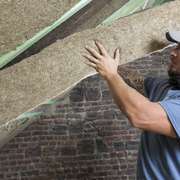
By applying a thin layer of an aerogel blanket or mat in these spots, it is possible to significantly reduce heat loss without major structural changes.
Applications in fenestration: high-performance windows with aerogel
Windows and doors have long been considered the weakest links in an otherwise well-insulated building envelope, but aerogel may change that. This is a proven game-changing material that will allow for previously unheard of window performance. This may change where we place windows and how big they are given the
Aerogel-filled triple and quad-pane units
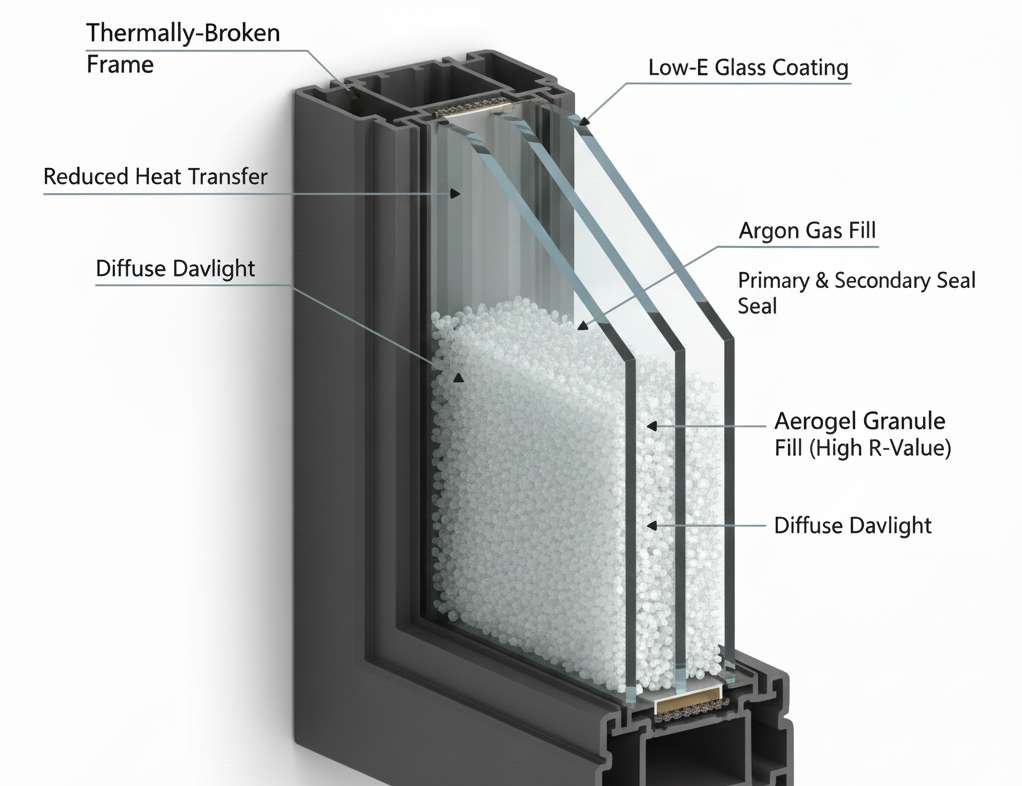
Traditionally, manufacturers increase window efficiency by adding more panes of glass and filling the gaps with low-conductivity inert gases like argon or krypton. Aerogel granules, however, provide superior performance.
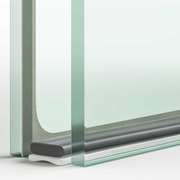
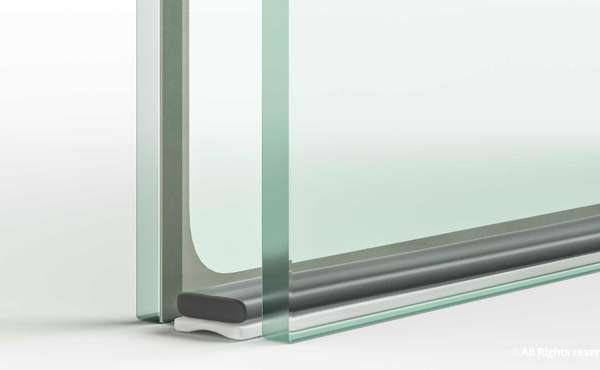
When finely milled aerogel particles are poured into the cavity of a double- or triple-pane insulating glass unit (IGU), the result is an IGU with a U-factor approaching that of an insulated wall. U-factors of 0.14 to 0.17 BTU/h·ft²·°F (0.8 to 1.0 W/m²·K) are achievable, which translates to an overall window R-value of R-6 to R-7, far exceeding the standard double-pane unit (R-2 to R-3).
Translucency vs. transparency
Aerogel in its granular state tends to scatter light and make the glass look translucent or cloudy, like a frosted pane rather than a clear one. This is obviously a drawback for picture windows where you want to see out, but a frosted-glass look can be a benefit in a lot of cases for privacy when there is nothing you want to see outside, or no one you want seeing you.
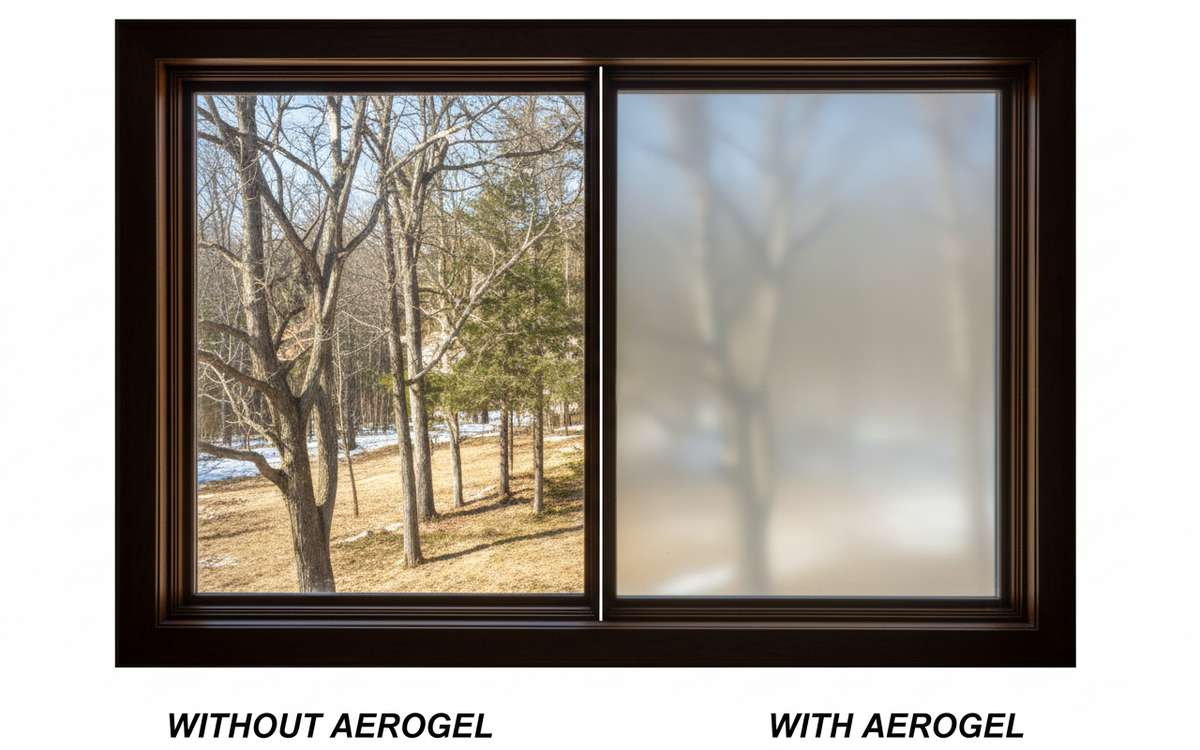
Aerogel in windows provides superior insulation value but has a frosted look to it, which would be a disadvantage in most cases, but an advantage in some cases where you want frosted windows for privacy, Image © Ecohome
Some uses where it could be a benefit are for bathroom windows, basement windows or windows facing neighbors homes etc, where there is nothing you want to see. Other uses where the cloudy look isn't much of a disadvantage would be skylights or overhead glazing that require diffuse light where you also want maximum insulation values.
A real benefit would be for north-facing walls where you get no passive solar heat gain so you want to limit windows, but you still want natural light. I could see this really being a thing for anyone trying to build to Passive House standards or get a home Passive House certified, since performance targets are so strict that windows that don't offer solar heat gain mean you need to beef up insulation in other areas.
How much do aerogel windows cost?
Aerogel is a premium material, and its high cost remains the primary barrier to widespread adoption. Homeowners need to weigh the upfront cost against the long-term energy savings.
The cost equation and payback period
In general, aerogel insulation is several times more expensive than traditional insulation options. However, the value lies in its space savings and targeted performance. If using aerogel allows a builder to avoid a complicated wall thickness increase or helps achieve the stringent performance target of a certified standard like Passive House that cannot be met otherwise, the cost is justified.
Aerogel windows typically cost a 200% to 500% premium (3 to 6 times more) on average compared to a similar-sized, double-pane, argon-filled window. The significant price difference is primarily due to the high material cost of aerogel and the complex manufacturing process.
- Material scarcity & production: Aerogel is a highly specialized material. The most effective optically clear (monolithic) aerogel for windows is challenging to manufacture at scale, requiring complex processes like supercritical drying.
- Niche market: Aerogel windows are not a mainstream, mass-produced item like argon-filled windows. This limits economies of scale in production and distribution.
- Superior performance: Aerogel offers a substantial performance boost in thermal insulation compared to any inert gas, which drives the high price point.
Despite the high initial cost, the superior thermal performance of aerogel leads to much lower energy loss, which can translate into significant long-term energy savings over the building's lifespan.
Does aerogel in windows allow passive heat gain?
Welcome to the downside of aerogel, though this is a minor point to concede. No, aerogel is not conducive to collecting passive heat gain from south facing windows. Passive heating requires radiation to pass through windows, and the very structure that severely limits heat transfer also prevents the passive collection of heat.
Aerogel for wall and roof insulation
While too costly to replace standard batt or foam insulation across an entire wall assembly, aerogel’s ultra-high R-value in a thin profile makes it invaluable for specific situations where thickness is constrained.
Historic and heritage building retrofit
In many regions- including the UK, New Zealand, and parts of the US and Canada- heritage designation limits the ability to change the exterior appearance or footprint of a building. Interior renovations must therefore be thin while maintaining thermal performance. A thin layer of an aerogel blanket (often coupled with plasterboard or vapor control layers) can provide a significant boost in R-value for these sensitive retrofits where only 1 or 2 inches (2.5 to 5 cm) of space is available.
The role of aerogel in eliminating moisture and vapor risks
When professionals use aerogel, they must consider the overall wall assembly and vapor control. Because aerogel is highly resistant to water absorption, it can maintain its thermal performance even in damp conditions, a factor highly relevant in humid climates like Australia and New Zealand.
However, placing an extremely high-R material in a specific layer of a wall changes the dew point location. This requires careful hygrothermal analysis to ensure that condensation does not occur on cooler internal wall layers, potentially leading to mold or rot.
Does aerogel have a high carbon footprint?
Yes, the manufacturing process of aerogel is more energy intensive than that of other insulation materials, but its performance makes up for it that. The core challenge in manufacturing aerogel is the required process called supercritical drying, which is an overly-ominous term for the drying process of removes liquid from a material without causing it to collapse.
For the ever-curious linguist in all of us, the term is derived from the process, which takes liquids past thier critical point into a supercritical fluid state.
-
Process: To create the aerogel structure, a wet gel must be dried under extremely high pressure and controlled temperature, often using supercritical carbon dioxide (CO₂). This process prevents the delicate silica structure from collapsing.
-
Energy intensity: The equipment, pressure cycling, and energy required to maintain the supercritical state and recycle the solvent make this process very energy-intensive and slow, leading to a high embodied energy value.
-
Embodied carbon: As a result, the cradle-to-grave embodied carbon footprint of aerogel is significantly higher than for mass-produced foam or fibrous insulations.
The payback period of embodied carbon for aerogel insulation compared to EPS foam
| Factor | Aerogel (blanket/granules) | EPS foam |
| initial embodied carbon | High (Due to supercritical drying) | Low (Simple expansion process) |
| Operational lifetime savings | Extremely High (Due to superior R-value per inch, especially in reducing thermal bridging) | High (Good insulating value, but less efficient than aerogel for thin profiles) |
| Break-even point | The long-term, superior performance of aerogel often allows it to recover its embodied carbon faster than EPS in specific high-demand applications (e.g., retrofits or Passive House), because it stops more heat loss over time in limited spaces. | The embodied carbon is recovered quickly, but the ultimate potential for reducing lifetime operational emissions is constrained by its R-value limit. |
Durability and tradeoffs
Aerogel is a remarkably durable material. Because it is essentially solid glass (silica), it is non-combustible and does not degrade over time due to settling or moisture damage like some other fibrous insulations. It is generally considered a permanent building material with a lifespan exceeding the useful life of the building itself.
Meaning, using aerogel adhere's to the green building principle of designing homes for easy decomissioning at the end of their functional lives for reuse or recycling building materials.
Canadian, US and global suppliers of aerogel
Aerogel is available globally, though its use is currently concentrated in regions with stringent energy codes or extreme temperature variations, such Scandinavia, Northern Europe, and the northern tier of North America. Homeowners should expect to work with specialty distributors or high-performance window manufacturers to source these products, as they are not commonly stocked at local lumberyards.
While the aerogel material itself is not proprietary, specific applications or forms of it (like ultra-clear sheets for glazing as an example) may be proprietary to the company that developed them (e.g., AeroShield).
Here is a list of companies who supply or manufacturer aerogel materials, including those for construction/window applications:
- AeroShield Materials: Focuses on ultra-clear aerogel sheets for high-performance windows, doors, and skylights.
- Aspen Aerogels, Inc.: Known for products like Pyrogel and Spaceloft, which are used in industrial, construction (including window frames), and automotive insulation.
- A. Proctor Group (Spacetherm®): Provides ultra-thin aerogel insulation blankets and laminates, including those used to reduce thermal bridging around window reveals.
- Aerogel Technologies, LLC: Supplies classic aerogel monoliths and 'Airloy' structural aerogels for various applications, including insulation.
- Cabot Corporation: A global specialty chemicals company that manufactures aerogel, often in particle form, for various industries including construction.
-
Svenska Aerogel AB: Specializes in silica aerogels for various applications including construction.
In brief: Aerogel for sustainable construction
Aerogel represents the peak of insulation technology, offering homeowners and professionals a solution for maximizing thermal performance in minimal space. Its primary value is not in replacing conventional insulation entirely, but in targeted applications- specifically fenestration and thermal bridge mitigation- where its high R-value and thin profile make achieving net-zero or highly efficient targets possible.
Now that you know more about aerogel, find more info about high-performance materials & green building techniques in the Ecohome Green Building Guide and these pages below:
-
Achieve high window R value with suspended film windowss
-
How to treat Seasonal Affective Disorder (SAD) with light therapy and daylight balanced home lighting
-
Energy efficient windows and doors: buying and installation guide
-
The pros and cons of Low E window coatings and choosing the right glazing surface







Comments (0)
Sign Up to Comment