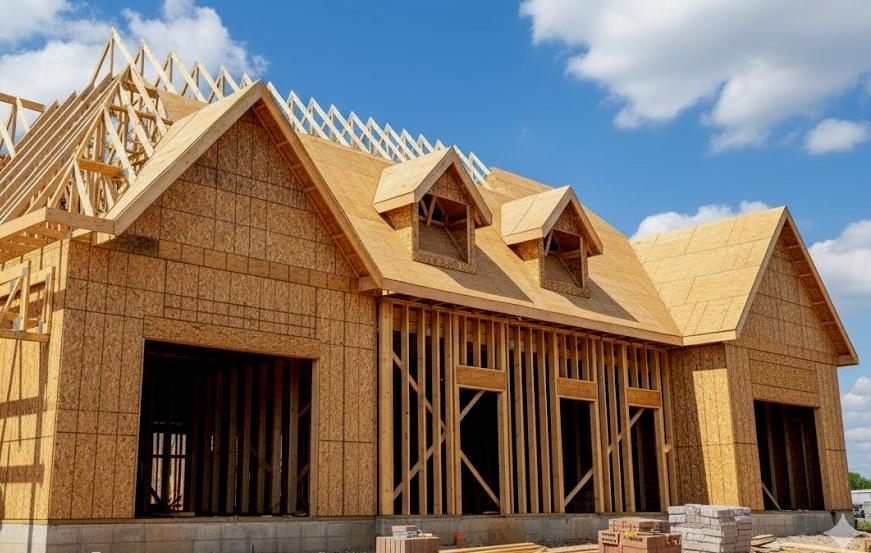







Tariffs on building materials such as lumber and metals, has driven up the cost to build or buy a home. Knowing an accurate cost per square foot is essential if you are to stay on budget while building and renovating, but also just to know how big a home you can afford to build so you can design accordingly.
Covid made it very difficult to determine the cost of labor and materials for home renovations and construction, and labor rates (and materials) never really returned to what anyone would call 'normal'. It's even worse now with the on-and-off nature of US tariffs on raw materials such as Canadian softwood lumber, and metals such as aluminum.
Every random tariff hike makes it even more difficult to pin down costs, but we wil try to provide a general idea of the premiums you can expect if you are in the process of designing a new home or taking on a renovation project in this age of unpredictable tariffs.
Here we distinguish between hard costs, soft costs, and land acquisition across mid-range, high-end, and luxury tiers. Again, this is only as accurate as the latest information we have, and would be subject to change if new tariffs are added of course.
- Construction cost tiers: mid-range, high-end, and luxury
- Global market analysis: construction costs by country
- Regional cost extremes: deep dive into California and Ontario
- Hard vs. soft costs: understanding the full budget
- Macro factors driving 2025 construction pricing
- In brief: key takeaways on building costs
Construction cost tiers: mid-range, high-end, and luxury
To accurately budget for new construction, it is essential to first define the level of quality and customization being targeted. This section focuses solely on hard costs, which are the materials, labor, equipment, and subcontractor fees directly related to the physical construction of the home. These estimates exclude land, permits, and professional fees.
| Home Quality Tier | US Average (USD/sq. ft.) | Canada Average (CAD/sq. ft.) | Defining Features (Finishes & Complexity) |
|---|---|---|---|
| Mid-Range / Production | $180 – $280 | $200 – $300 | Standard architectural plans, builder-grade or modest energy efficiency, basic cabinetry, laminate or engineered flooring, simple rooflines. |
| High-End / Semi-Custom | $280 – $450 | $350 – $550 | Custom floor plans, good insulation and air sealing, high-quality windows, semi-custom millwork, high-efficiency mechanical systems, stone or engineered wood siding. |
| Luxury / Architect-Designed | $450 – $800+ | $550 – $1,000+ | Unique architectural features (e.g., curved walls, cantilevers), Passive House or Net-Zero standards, custom-designed millwork, premium natural stone finishes, high-end smart home integration. |
Global market analysis: construction costs by country
Construction costs vary dramatically by country based on material sourcing, labor agreements, and regulatory environments. For a global audience, the following table provides comparative hard cost estimates (excluding land) for a high-end custom build in key English-speaking markets.
| Region | High-End Hard Cost Estimate (Local Currency/sq. ft.) | Key Cost Drivers |
|---|---|---|
| United States (US) | $280 – $450 USD | Regional labor rates (highest in coastal metros), material supply volatility, and complexity of local codes. |
| Canada | $350 – $550 CAD | High labor costs, extended heating season requirements (insulation), and costs related to importing specialized US materials (affected by tariffs). |
| United Kingdom (UK) | £250 – £450 GBP | High density of residential areas, challenging logistics in small sites, and stricter thermal performance standards. |
| Australia (AU) | $4,000 – $7,000 AUD per square meter (approx. $370 – $650 AUD/sq. ft.) | Distance from major manufacturing hubs, specialized construction for cyclonic or bushfire-prone areas, and a scarcity of skilled tradespeople. |
| New Zealand (NZ) | $3,500 – $6,500 NZD per square meter (approx. $325 – $600 NZD/sq. ft.) | Strong focus on seismic resilience, material import costs, and high demand for quality builds under the Healthy Homes Standards. |
Regional cost extremes: deep dive into california and ontario
Cost extremes are most evident in high-growth, densely populated metropolitan areas. California and Ontario represent the highest construction cost environments in North America, where local factors heavily inflate costs beyond national averages.
California: complexity meets scarcity
In high-demand markets like the Bay Area and Southern California, the average hard cost for a custom home routinely starts at $450 USD per square foot and can easily exceed $1,000 USD/sq. ft. for luxury construction. The primary drivers are:
- Labor rates: Wages for skilled trades are among the highest in the world, reflecting the high cost of living.
- Regulatory complexity: Seismic requirements, stringent energy codes, and increasing pressure for low-carbon materials add complexity and expense.
- Soft costs: Development fees, building permits, and planning approvals are extensive.
Ontario: fees, labor, and a long winter construction season
In the Greater Toronto Area (GTA) and Ottawa, hard costs for high-end homes fall within the $500 to $750 CAD per square foot range. This is primarily influenced by:
- Development charges: These municipal fees, used to fund growth-related infrastructure, are some of the highest in Canada and can add $90,000 to over $150,000 to the cost of a single-family home before construction even begins.
- Extended building envelope: The northern climate necessitates thicker wall assemblies, higher insulation values (R-values), and premium air sealing, which increases material and labor costs.
- Labor market: A tight, high-wage market for specialized trades, particularly for Net-Zero and Passive House projects.
Hard vs. soft costs: understanding the full budget
Homeowners often budget only for hard construction costs, leading to surprise expenses. Professionals know that soft costs and land can represent the majority of the total project investment.
Hard costs: where the money goes
On average, the hard costs for a high-quality home typically break down as follows (note that interior finishes are the most variable component):
- Foundations and framing: 25%-35% (includes excavation, slab, and structural shell).
- Exterior envelope (roof, siding, windows, doors): 15%-20%.
- Mechanical, electrical, and plumbing (MEP): 15%-25% (HVAC systems like heat pumps and Heat Recovery Ventilators (HRV) fall here).
- Interior finishes (flooring, cabinetry, fixtures): 20%-35%.
Soft costs and land: the hidden majority
Soft costs are non-physical expenses, and they are non-negotiable. They often surprise first-time builders and can account for 15% to 30% of the entire budget (excluding the land purchase itself).
- Architectural and engineering fees: 8%-15% of the construction cost, highly dependent on complexity.
- Permits, inspections, and development charges: Varies wildly by municipality, often ranging from $10,000 to over $150,000 in major urban areas.
- Financing costs: Interest on construction loans and mortgage fees.
- Land acquisition: This is often the single largest line item, especially for new builds replacing an existing structure in a desirable location.
Macro factors driving 2025 construction pricing
Several global and regional factors continue to exert upward pressure on construction costs in 2025.
Tariffs and supply chains
The lingering effects of global supply chain disruptions combined with trade policies such as the tariffs on steel and aluminum between the US and Canada continue to inject volatility into material pricing. Lumber, concrete, and engineered wood products also face price spikes due to logistics and energy costs, forcing builders and homeowners to constantly review budgets.
Labor and skill shortages
The construction sector in the US, Canada, the UK, and Australia faces chronic labor shortages. This is particularly acute for trades proficient in advanced energy-efficient techniques. For example, finding skilled professionals to install and commission high-performance systems like air source mini split heat pumps can lead to delays and higher hourly wages.
In brief: key takeaways on building costs
The cost of building a new home is a reflection of local economic forces, regulatory requirements, and the client's choice of quality. Land is almost always the greatest expense in metropolitan areas. Hard costs are negotiable only in the selection of materials and finishes, while soft costs are largely dictated by the municipality and project complexity.
Now that you know more about home building costs, find more info about sustainable construction and green building techniques in the Ecohome Green Building Guide and these pages below:
-
Top tips for planning a green home on a budget
-
Choosing high-performance windows and doors: A comprehensive guide
-
Are prefab homes cheaper than site built homes?
-
Should I renovate my home or tear it down and rebuild?














Comments (0)
Sign Up to Comment