









Where to find black granite countertops for kitchens and bathrooms
Choosing the right countertop for your kitchen or bathroom is one of the biggest decisions in a kitchen renovation. Homeowners across Canada are often faced with a dizzying array of materials, but natural stone, especially granite, remains a top contender for its timeless appeal and rugged durability. When you start your research, you likely have questions about more than just looks. How much do granite countertops cost? Are they hard to maintain? And how do you choose a stone that is not only beautiful but also a responsible, sustainable choice for a green home?
This guide will walk you through the key considerations for selecting natural granite countertops, with a special focus on a locally sourced Canadian option. We'll explore why choosing local stone is a smart decision for both the environment and your project's potential green building certifications, and we’ll introduce you to some stunning black granite quarried right here in Canada. By the end, you'll understand the clear benefits of natural stone and feel confident in making a choice that is both stylish, sustainable and that protects the health of the contractors who cut and craft the perfect countertops for your kitchen or kitchen island counter.
Why Natural Stone is a Safer Choice than Engineered Quartz
In recent years, a serious health crisis has cast a shadow over the kitchen and bathroom countertop industry, specifically concerning engineered stone, also known as quartz counters. The issue stems from the extremely high concentration of crystalline silica (often over 90%) in these products. When fabricated, quartz kitchen island countertops and bathroom vanities release fine, toxic dust. Workers who inhale this dust are at high risk of developing silicosis, an incurable and often fatal lung disease. This has led to a global re-evaluation of material safety, with countries like Australia banning high-silica engineered stone entirely. While there are emerging low-silica and silica-free products, it's critical to understand the risks of traditional quartz. For those still considering this material, it is vital to know how to choose the best manufactured stone countertops or kitchen counters by verifying their composition and the safety practices of the fabricator.

Choosing Local Granite: A Sustainable Decision for Canadian Homes
There are substantial environmental impacts that come with shipping building materials around the globe, particularly something as weighty as granite. It is for this reason that green building programs have long encouraged the use of local materials. In the past, programs like LEED for Homes v4 offered a specific credit (MR5) for sourcing materials regionally. While the structure has evolved, the principle remains a cornerstone of sustainable design.
Under the new LEED v5, the focus has broadened to a more holistic view of a product's lifecycle. While the specific 800km/2400km rule is no longer a standalone point, choosing local Canadian granite directly contributes to earning credits under the Building Product Selection and Procurement category. Using local materials dramatically reduces the 'embodied carbon' associated with transportation, a key metric in a product's lifecycle assessment (LCA). For architects and specifiers, sourcing granite from a Canadian quarry is a straightforward way to improve a project’s environmental footprint and align with LEED v5’s goals for decarbonization.
To get a point for buying local under the previous standard, LEED had a limit of 800km by truck or 2400km by rail or water for the transportation of building materials. This can serve to limit material choices somewhat, Italian marble for example won't win you any points.

Canadian Black Granite: A Closer Look at a Local Gem
This new Cambrian black granite quarry is located in Saguenay and operated by Polycor, which has thirty sites, the majority of which are in Quebec. This local source provides a fantastic opportunity for homeowners and professionals in Eastern Canada and the Northeastern United States to access a world-class counter material with a minimal carbon footprint.
"Of all our products, Cambrian black is one of the best selling and most beautiful, and we are the only supplier in Quebec." says Geneviève Robicheau, marketing director at Polycor.
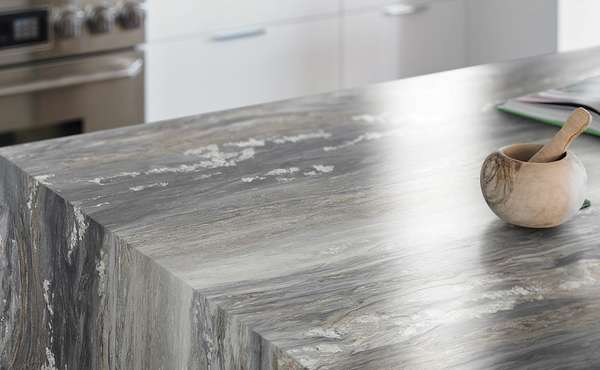
Granite is all natural, undergoes no colour treatment, and it isn't covered with resin. So there are no negative health impacts due to material off-gassing and surface finishes. It is simply polished, depending on the customer's request, though honed (matte) and leathered (textured) finishes are also popular choices that offer a different aesthetic. "We sell a semi-processed product, and it is the kitchen cabinetmaker that makes the final cut to suit the needs of the buyer."
One of the greatest advantages of granite is its durability. As a natural igneous rock, it is highly resistant to heat from hot pots and pans and is very difficult to scratch. When properly sealed (a simple process that usually needs to be done every year or two), granite is also resistant to stains and bacteria, making it a practical and hygienic choice for busy kitchens. Its natural mineral composition, primarily quartz and feldspar, gives each slab a unique character and depth that cannot be perfectly replicated by manufactured products.
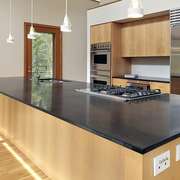
Granite is a low-impact, natural, and extremely durable building material. And if you live within a reasonable shipping distance of Saguenay, you can get a black, grey or charcoal counter now and still contribute to a more sustainable, lower-carbon home project.
Now that you know more about granite counter tops, find more pages about sustainable and resilient green building techniques here on these pages and in the Ecohome Green Building Guide pages
-
How to fix a leaky faucet for almost free
-
Kitchen waste - design ideas for compost and recyling bins
-
Quartz counter made from recycled glass and bottles
-
Choosing the best kitchen countertops - Low silica, healthy and durable









Comments (0)
Sign Up to Comment