




Geothermal heating systems for homes
Domestic Geothermal heating systems can be a great way to heat a home, replace a furnace, and are labeled as money savers. Question is, are they worth the hype? Here's a quick view first of how they operate.
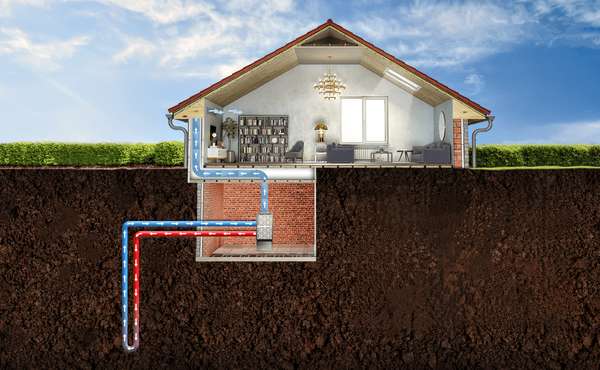
Starting at depths of between 6 and 10 metres, the temperature of the earth is no longer influenced by variations in surface temperature, and stays relatively constant at around 8 to 10 C. So the underlying principle of geothermal heating and cooling is to use that consistent interior earth temperature to balance our wildly varying North American & Canadian surface temperatures.
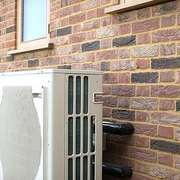
With the use of heat pumps, geothermal heating and cooling systems extract heat energy and transfer it into buildings, saving approximately 50 to 60% on heating and cooling costs, depending on the fuel being compared to.
In summer months, geothermal cooling functions in a similar way to standard air conditioning, only heat is not simply ejected into the outside air, but rather deposited deep in the ground for future use. The result is guilt-free air conditioning because the heat extracted in summer months is actually used to warm the earth deep below, heat which will increase the efficiency of the ground source heat pump in winter months.
Geothermal home heating systems:
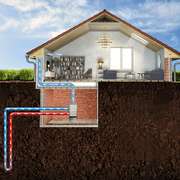
Vertical closed-loop geothermal systems have a sealed U-shaped pipe of high density polyethylene that carries a heat transfer fluid (usually a water / methanol mix) in a continuously circulating loop allowing an exchange of heat by conduction. As the liquid returns to the surface, either heated or cooled depending on the season, the additional or reduced amount of heat in the water is used to condition the home. The required depth for this system is generally 300 feet or more, and the cost is calculated by the foot. Through the nose, but by the foot.

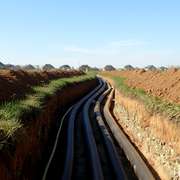
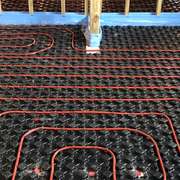
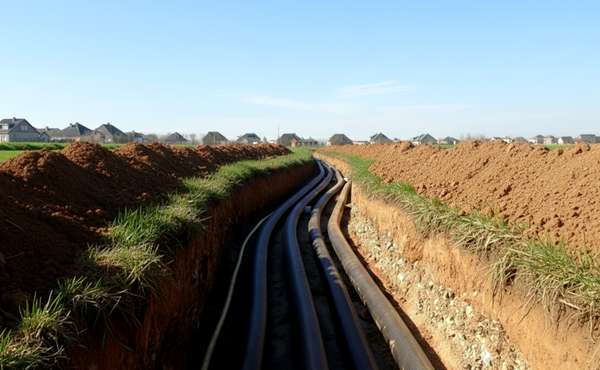
Horizontal closed-loop geothermal systems function in the same manner as vertical systems, except that pipes are run back and forth 6 to 10 feet underground. Installation involves excavating trenches (at least 300 feet of them), rather than digging a well.
Horizontal ground source heat pump systems can be cheaper to install but require a significant amount of space, and it does some pretty intense damage to any ecosystems that lay in its intended path. For a given length of pipe, horizontal loop systems are a bit less efficient than vertical loop systems, as they can be more easily affected by surface temperatures. The other downside is that if or when there's a leak in the circuit, with a horizontal mat or grid style system the whole garden area has to be dug up again in search of a tiny leak that is losing the system pressure.

Open-loop geothermal systems use ground water pumped directly from a supply well (75 to 100 feet deep) in order to draw and inject heat. Water is pumped out of the first well, and after the heat exchange is carried out, it gets injected into the second well.

Open-loop systems have a very high thermal efficiency and installation can be up to 50% less expensive than vertical closed loop systems. However, conditions necessary for the proper function of these systems are rarely found in urban areas, as they require an abundant source of ground water and a high water table.
Will geothermal heating save me money?
That truly depends on the size of the project to heat. No geothermal system is cheap to install, and because it offers only a reduction in consumption, the return on investment is really only viable for larger buildings. For this reason geothermal is more suited to commercial or multi-unit residential projects of substantial size.
A home would have to be quite large, and somewhat poorly-insulated to actually make it pay for itself in a reasonable time frame. In many cases, particularly with moderately-sized new homes being built, that large of a financial investment towards energy efficiency could offer much greater returns if put towards heat retention instead - better windows, additional home insulation in new build, insulating existing walls from the outside during a house renovation, or better tapes and membranes for air sealing, etc.
Ball park pricing for a geothermal system: For an averaged size home (2000 sq. ft.) a GSHP will easily cost $30,000 to have installed, and that is in exchange for a monthly saving of about 50% on the heating bill. So payback for the average single family home is simply too far away to make this a financially competitive option with all but the highest consuming homes - and even then only when the boiler or furnace has failed and needs replacement.
That same investment of $25,000 (or perhaps less) in a better thermal envelope would likely reduce heating bills easily by 70 or 80%, perhaps more. Geothermal energy is an excellent global technology, but poorly insulated single family homes will get far more bang for the buck if the money is put into insulation instead, or balanced between energy saving renovations and high efficiency heat pumps especially if choosing from the best heat pumps in our comparison guide. Also, this guide compares geothermal heating to ASHPs to explain which is best for homes.
Now you know more about geothermal heating for homes, learn more about sustainable home comfort, energy efficiency and how to reduce the carbon footprint of homes on the following pages and in the Ecohome Green Building Guide pages.
Find more about green home construction and reap the benefits of a free Ecohome Network Membership here. |





I've read an article, and still think that geothermal heating systems are really great for commercial usage. In case if you wish to provide some warmth into a normal private house - thinking about insulation is more profitable for the pocket. Yet, when the cost is not an important option, properly installed residential geothermal heating system is a solid solution, which will free you of many standard troubles. I use a system in my house, and I'm pleased! If you think you got enough bucks in the pocket - think about it.
I'm a little confused by your statement that geothermal is not a reasonable alternative for residential use, except in multi-residential or larger, and/or poorly insulated (older) homes. If we need to shift to carbon neutral housing stock, which I understand is one objective of Ontario's new Climate Action Plan (www.ontario.ca/page/climate... ), do we simply accept that phasing out natural gas and switching to electricity for heating is our only reasonable alternative? I'm also a little dismayed with the statement that you can "possibly even eliminate [your heating costs] all together" by investing more in insulation. Is a passive house retrofit (or even new construction) really less expensive than a residential geothermal system? Also, once you've made the investment in geothermal heating and cooling, shouldn't your heating / cooling costs be eliminated (except for the cost of running the pumps) instead of reduced by 50% as you've suggested? I agree completely that the first step should be to insulate your home as much as is reasonable - but there are limits to how much insulating factor you can get in the walls and roof of a standard house, especially if you are retrofitting. Shouldn't we be looking at the longer term impacts of the alternatives considered? I'd welcome more discussion about this.
From an economic standpoint it is not reasonable. Dollars spent to dollars returned.
You need to determine in your own mind if the money it costs to install a geo thermal system is worth the cash. Everyone one veiws this a little differrently. Some put value only in it just saying them money, while others who have lots of money may put way more value in the "green" aspect.
Cannot fairly say either veiw is less relavent, but if you dont have the cash its pretty much imposible to spend it!
I personally would like to see (if we are to continue with the carbon tax) investments made into developing better geo thermal technology. In ways of affordability, long term stability, and minimal enviromental impact.
I've been thinking about the phasing out of using fossil fuel, on and off for some time now. The only thing i'm certain of at this point is electricity is not the answer.
What about if you purchase a home with geothermal system and plan on increasing the size of the home? Can you "add" on to the system per se?
The challenge with geothermal heating and cooling is not he technology, it's the cost of giving away the energy for free. If individual home owners had to build gas pipelines from their homes to the source of the gas - which they would then get for free - it would be too expensive as well.
Governments need to developed policies to encourage companies to build district based geothermal systems. This will require putting a price on the geothermal energy - like we do with fossil fuels - that homeowners pay for as the use it. Homeowners will then update their furnaces and air conditioners to heat exchanges when replacing them. The cost to the homeowners for switching energy sources will be similar to replacing their current systems, but significantly less than building an entire geothermal systems from scratch.
This type of approach will encourage businesses to invest in building the carbon friendly infrastructure needed to achieve the carbon reduction targets our government is calling for.
Definitely bumping an old post here, but you've nailed it on the head Paul. The systems you describe have been in use throughout the UK for some time now. A municipal heating system throughout a town with the homeowners branching off the main systems.
I think it could really work here as well.
NO? not really if someone build a new home go for it. because save on furnace and AC. if the furnace is old and needs to be replace maybe is a good time to do the change.
i also would put solar panels on the roof for extra heat.
Seems every alternate method of energy consumption has its plus and minus.
Obviously with solar panels the worst thaight is the need to store in extremely eco unfreindly batteries.
im currently trying to find accurate data on tue calculations of possitive vrs negative inpact on differrent sources of energy. So far I have not found information that is unbiased.
I installed geothermal 8 years ago and have a 4100 sq ft house with 12 foot ceilings on the ground floor, 10 ft on the second, so there is a lot of space to heat or cool. With the government rebates (2) it paid for itself in about 5 years over oil.
The problem arose with McGuinty and Wynne. I did not predict the huge increase in the cost of electricity to run the condensers. Now with the 25% drop in the cost of electricity and the new carbon taxes on oil and natural gas, the equation has flipped again.
If the government of Ontario stops screwing up our electricity system,then geothermal is a great idea, and really pays off. Being at the mercy of an incompetent bureaucracy is not a good thing. You cannot plan for what they will do next.
That 25% reduction has now changed to a17% reduction with Hydro One increasing it's rates ,again. Guaranteed those rates will rise again ,the power utilities in Ontario have huge legacy costs just in pensions . I agree that dealing with an incompetent bureaucracy is a pain in the *** . I think geothermal is a great idea but natural gas is the way to go if available in your area in Ontario.
Don't think you will see natural gas phased out in Ontario . Natural gas is a very clean burning fuel . Plus the voters would raise a huge stink .
My most recent bills are actually 32% lower. I live in a medium density zone where the distribution rate was very high. This dropped significantly and with the 8% PST reversal and the actual usage cut in prices, I get this bigger reduction. The distribution is the main reason why my savings are greater. Wynne must be removed to make these reductions permanent. It is possible to remove these excess Green Energy and Staffing costs. Geothermal is now giving me the savings it did when installed.
Electricity is also needed for the heat exchange condensers as well as the pumps. That's where the biggest usage is. Bottom line it has to pay for itself in a reasonable time frame. With the total cost of electricity in 2016 being as high as it was and with future increases for more planned wind turbine farms and fat staffing costs, the calculation did not work. In fact keeping with oil or gas would save you money, or better still burning wood.
Now with Wynne's re election re configuring of hydro rates and cancellation of billions in future wind farms subsidies and reduction in the solar subsidy etc. etc., coupled with carbon taxes on heating oil and natural gas, the equation is now viable again, so long as this woman does not get re elected and the rates begin to climb again.
Right and natural gas is a lot cheaper than electric baseboard heating. Cost is the key to any heating decision, both the payback period on the installation cost and the monthly operating cost. Cost trumps touchy feely green sentiments at the end of the day. If we want more green electrical and geothermal heating, get the cost of electricity down.
I just noted that the Canadian distributor of my geothermal equipment closed up as did the installation company. Why - no business!
Bought a house 27 years ago . The developer got into an argument with the gas company . The house was electric heat and water . Within a year of owning the house the gas company ran gas lines in the neighbourhood .The deal was if you put in a gas water heater they would do the house hookup lines free . Did that ,then converted the house to gas heat ,and later gas stove /oven . Really good decision . Electric heat is a dry heat and a lousy way to heat a home . What pisses me off is we converted the house to led lighting and the electric bill keeps increasing . Let's face it the whole Ontario electrical system is a sham .Enormous salaries to management and staff .Pension plans and benefits that are an insult to average ratepayers .
Well solar is dead in Ontario residential now as who is going to put a $40,000.00 solar system on their roof with the drop in the rate the province now pays for the power your system produces . The fact is Ontario never needed solar or wind turbines. Ontario is producing more electrical power than it needs . The smart thing to do for Ontario if they need more power in the future would be to get it from Hydro Quebec and Manitoba power .The power is hydroelectric so it is "green " energy and the costs would be much cheaper as those provinces have already built their infrastucture .The Ontario infrastructure is there ,basically power lines . Ontario does not have to produce it's own power if it can get it cheaper from other provinces . The mindset needs to change !
Looking everywhere for case studies on the web and from manufacturers. If this technology is so good and is in fact so efficient there should be a world of data to support this industry. The fact that it's not sends a real message regarding residential install short of a commercial application. I'm looking at the potential for a closed loop install on a river which freezes in winter because as I read it, if I drill certified wells the water aquifer temp will drop year after year due to my almost constant extraction of superheat. Comments suggestions?
Hi Don,
Your posts were intriguing. We are building a house in Burlington where
Natural gas line is not available (no prediction for when it will be either)
Our house is approximately 3800 sq ft with 10ft ceiling on ground floor and unfinished basement, and 9ft second floor - so not too far off from your size. Would you say a closed loop horizontal system is sufficient to heat a home like ours or would we also need propane heating?
Any advice?
You have to make the decision weather to plumb in for a gas forced air system now as you are in the construction phase . Is this a reno or a new development? What heat source do all you neighbours use? If new construction and a new development how many people want gas? That might be some leverage if a lot of people want gas and you all form a group committing to natural gas . Then call the gas company. If new construction you are probably well insulated .Would a heat pump, air to heat exchanger do ? That gives you air conditioning in the summer too. You have to talk to a heating contractor to do the math on what would work for your new home . If gas is coming then it would be wise to plumb in your ductwork now . Just a tip I just replaced my furnace .Costco was the best deal 70,000 BTU 2 stage ,96% efficient they beat the other estimates by $700 to $1000. plus the unit they put in was better and a better warranty . Costco partners with a local reputable dealer . Plus check the provincial rebates ,you may qualify for a rebate for an energy efficient unit /system . For me it was $3445.00 with a $300.00 Costco rebate ,$250.00 provincial rebate and 2% rebate on my Costco credit card . Good luck .
How much to instal the geothermal unit and what is the house sq.footage? How much of a provincial rebate ?
I am cautiosly looking at going with geo (heating/cooling) and pv (electrical).
I have a 2000 sqft, two story, attached garage home in Edmonton. The house was built in 2004 - it's not too old but probably not very efficient either. My plan is a follows:
- Start with a home energy audit, including a blower test. I hope I could make some quick gains looking at the Attic, Basement and air sealing/insulating it.
- I am assuming I could reduce my heating/cooling requirements cost-effectively by about 25% - and a lot of it could by DIY (~$5,000);
- I am also assuming that air sealing and insulating the Center of the house to get to a low ACH/high insulation value (walls, windows) would be cost prohibitive, work intensive and (in some areas) way beyond my DIY skills (~$25-$100K);
- Got a rough estimate to put in geo to replace my heating/cooling needs (no AC right now) for about $35K. I hope that by addressing some air tightness and heat losses, I might be able to lower this cost even further (4 ton system instead of 5 ton)? My furnace is 14 years old and may need replacement within the next 10 years at a cost of $3,000-$5,000 so part of investment into geo offsets that;
- Got a rough estimate on PV installation to offset my electricity consumption at about $15K. I need to replace the roof first which could potentially decrease PV installation costs if I were to move some vents around to better position the panels and install a compatible racking system at the same time.
So being the optimist that I am, here is the cost structure:
- Attic/Basement air-sealing/insulation - $5K
- Geo - $30K (lower than the estimated $35K due to better air-tightness of the attic and basement)
- Roof - $5K (a lot of DIY)
- PV - $10K (including DIY (panel racking) when working on the roof)
So for a total of $50K I would be off natral gas and producing my own electricity (net zero on an annual basis). So, the payback period for PVs @$10K is about 7 years with a projected warrantied life of 25. Payback period for geo @ $30K is about 20 years with a projected life of well over 50 years. I am not counting changes in utility costs and maintenance. Given the federally promised $40K zero percent, 10 year home efficiency improvement loan, I could be net-zero CO2 in 10 years (Yes there is still a gap of $10K between total cost of $50K and the federal loan of $40). Also, my loan payments woud be about 38% higher than my current utility bills for the next 10 years.
Comments?
There isn't too much we can dispute or confirm without spending a day crunching numbers, and the best advice we can ever give is to do exactly what you've done, which is to weigh the options and not rush into a decision. A few things stand out that may be worth you re-investigating -
I'm not sure that investing in 5K for both the basement and attic combined is taking full advantage of potential heat savings. It depends on how big your house is, how airtight it is and how well it is currently insulated.
One example - If it was built in 2004 I'm not certain you'd have any insulation at all under the baseme floor, so just a DIY floor insulation project with cheap flooring on top will eat up at least 5K in materials alone I imagine even for a small basement.
And don't count on recouping 5K in geothermal installation costs by adding 5K in insulation. System sizing doesnt' offer so many options that you can go up in such small increments.
I think your best bet it as you suggest, start with an energy audit. It's impossible to solve an equation accurately with a bunch of variables and you currently have a lot of those.
It's good that you have a base of ideas already, but wait till you energy advisor tells you where you are best to insulate and how much to add, and you may find that rather than dropping 5K on insulating and 30-35K on geothermal, you may be best to install 20K on insulation and skip the geothermal altogether. Just food for thought.
Each of the above scenarios assume ducted Forced Air Gas (or oil) for cost comparisons. Here's mine, which starts from a different place:
- built 1972, electricity was cheap, electric baseboard heat, 1800 sq ft, high insulation levels (brand new complete attic insulation in 2015 - closed-cell spray foam and blown to R70).
- two capped unused fireplaces, no ductwork, no A/C or airhandling system, electric hot water, wide open-concept side-split, large-ish lot (100x100), across the road from a mid-sized lake in central Ontario
- currently pay about $7,000/yr in electricity after rebates, has been as high as $9,000+
Note that I will not consider switching to a combustion-based fossil fuel system.
What I am trying to determine is what the costs vs savings might be, given that I don't have any ducting or air handling system.
Can anyone offer insight?
hi there ... Thank you the Ecohome author for the informative air condition installation guide.. The post and the comment are very rich with information that help me to create my new research blog https://acrepairinreno.com cheers all of you !
hi there ... Thank you to the Ecohome author for the informative air condition installation guide. The post and the comments are very rich with information that help me to do my research.
What about electricty!? Why not use the same geothermal to both heat, and be a energy source? you could use the heat to run a turbine and generate electricity for the airconditioner... ???
How much to instal the geothermal unit and what is the house sq.footage? How much of a provincial rebate ?
I won't comment on the types of systems you list in the article because they are not the type I am entertaining. I am looking at land in Tennessee where the ground temperature is 19-20C, this eliminates the need for a heat pump and can run exclusively on either forced liquid or, as I prefer, a forced air system. Rather than worrying about fluid leaks and pressure losses, a simple forced air system would be DESIGNED with holes because it's an open loop. Air is pushed (forced draft) down three black plastic drainage pipes of about 30cm diameter with weep holes in the bottom a minimal layer of gravel around them to promote elimination of condensation of humidity from the ambient air used in the system. The pipes run out in a single trench of about 100M in length and return to the same area where air is also pulled (induced draft) from their other end and then fed into the ventilation system. Considering I will be doing the construction myself and intend either an earth bag or earth berm structure, this will be extremely inexpensive and have far less in both power consumption and maintenance requirements. If a fan dies replace it, they don't cost much. Yes, I will disrupt the soil, but woodland and grassland type environments recover quickly and geothermal is completely unsuitable for wetlands locations. Why would anyone build in wetlands anyway? Aside of any environmental concerns you might have, the engineering is a nightmare.
We had an old (1910) large wooden home with fueloil heated steam system. We had done some insulation improvements over the years but they were not very effective. The steam boiler died in spring atnendbof heating season (2015). that year our fuel oil bill was $15,000 dollars for 3700 gallons of fuel oil. At that time this was a 7 bedroom three story house. It had 4 window air conditioners. We are rural and do not have access to pioed in natural gas. the cost of the geothermal was high partially due to the need to install ducting throughout the house. The geothermal pushed our electric bill up by $3000 a year. However the savings in heating costs were between $12000 and $9000 a year so the pay back period was under 9 years. in 2017 we had a major house fire and the rebuilt house is MUCH better insulated. Our electric bill is now at the same level as it was BEFORE the geothermal was put in. Because the ground loops were undamaged in the fire and incorporating ducting into the rebuild was much less exoensive, reinstalling the geothermal was less expensive than original installation. Insurance company paid for it. The house fire was caused by the explosion of an unattended laptop computer left on a bed while recharging. Had nothing to do with geothermal.
Remember to tell your home owner insurance company about installation of green improvements.
We just got solar panels.
Large 1910 built wooden home in Maryland Usa. Fuel oil steam furnace. In 2015 annuel fuel oil bill was $15,000. (Fifteen thousand dollars) Boiler died. Cost of geothermal was higher because we had to put ducts in house - $90,000 but that still is less then 7 years fuel oil. The cost of adequately insulating this old house would have beeN high
we did have solar panels
In 2018 devastating house fire caused us to have an almost complete rebuild of house with excellent modern insulation. Heat geothermal heat pump replacement was also covered by insurance. Got new solar panels in 2023
As of now Sept 2023 we are producing more electricity than we are using. In theory local utility is buying the excess from us.